 specialicon

AI hair analyzer function for all similar machine very similar. Only a few detecting report different. The AI database and camera usually cause difference.
AI hair anlayzer report
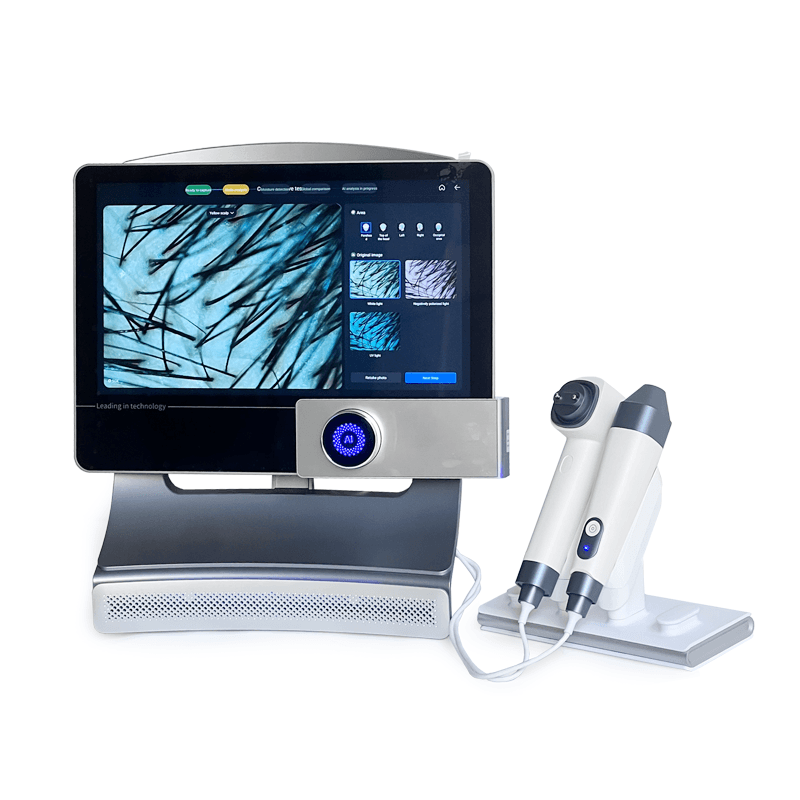
T5 AI hair Scalp Analyzer
The T5 AI Intelligent Scalp Analyzer is developed to solve various scalp concerns. It integrates ISP image processing technology and four-spectrum light-sensing imaging technology. Equipped with a high-definition lens and four specialized light sources, combined with powerful AI algorithms and image processing capabilities, it converts microscopic scalp conditions into intuitive visual images for professional analysis.
Designed for professional and objective scalp assessment with flexible operation, it can detect 5 key scalp areas: forehead, left side, right side, crown and occipital region. It comprehensively evaluates follicle health, sebum secretion, inflammation, scalp barrier function and potential hair loss risks, helping practitioners fully understand the real scalp condition of clients.
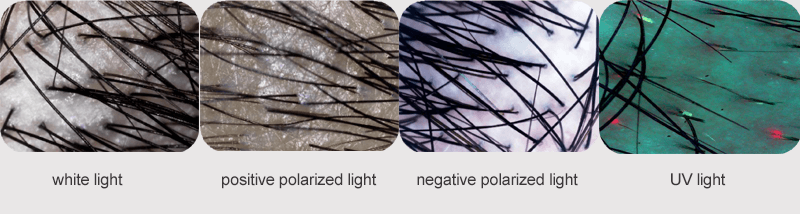
AI hair anlayzer – White Light
Under uniform natural light, stray light is filtered out to clearly display visible epidermal scalp issues to the naked eye. With white light illumination, you can observe scalp texture, skin grooves and skin ridges, and check scalp color, hair density, hair thickness and scalp sensitivity.
AI hair analyzer -Parallel Polarization
It adopts parallel polarization technology to capture images reflected from the scalp stratum corneum. This technology suppresses scattered light under the scalp surface, enhances epidermal reflection and improves the imaging clarity of scalp surface textures. By magnifying local details, it clearly identifies oiliness and irregular scalp texture.
AI hair analyzer – Cross-Polarization
A special cross-polarizer lens set is used to filter direct reflected light. Cross-polarization mode captures reflected light from the basal layer and dermis of the scalp. Rich in melanin and hemoglobin, these deep layers can be visualized under cross-polarized light to show capillaries and pigmentation. It assists auxiliary diagnosis and efficacy tracking for white hair, hair thickness, follicle health, dandruff, red blood streaks, sensitive inflammation and abnormal scalp pigmentation.
AI hair analyzer – 365nm UV Light
With a wavelength of 365nm, scalp cells and tissues can convert invisible UV light into visible fluorescence, turning the scalp into a light emitter. UV light penetrates different scalp layers and excites distinct fluorescence signals to form diagnostic images, supporting detection of follicle opening blockage, dandruff and fluorescent agents.
AI hair analyzer report
Scalp Oil Secretion Analysis
Under polarized light, the system observes oil secretion on the scalp surface. The AI algorithm marks excessive sebum areas with yellow fluorescence and quantifies oil levels with data for straightforward viewing. Too much sebum leads to a greasy scalp, easily trapping dust and breeding bacteria and fungi such as Malassezia, which may trigger seborrheic dermatitis, folliculitis and even hair loss. Insufficient sebum causes dry scalp, dandruff, dry and brittle hair.
Follicle Blockage Detection
Under UV light, follicle blockage can be visualized. The algorithm marks blocked follicle areas with yellow circles and presents the status with supporting data. Excess sebum that cannot be discharged in time accumulates inside follicles and causes blockage. Blocked follicles create ideal conditions for bacteria and fungi to multiply, easily inducing folliculitis, seborrheic dermatitis, scalp redness, swelling, itching and pain, and damaging scalp health.
Dandruff Analysis
Dandruff distribution on the scalp can be detected under UV light. The algorithm displays dandruff areas as irregular white blocks with data visualization. Malassezia normally coexists on the scalp, yet overgrowth breaks down sebum into oleic acid, which irritates the scalp, accelerates cuticle proliferation and generates massive dandruff.
Scalp Sensitivity & Redness Check
Negative polarized light reveals superficial scalp redness and capillary distribution. The AI algorithm highlights sensitive zones in red for data-assisted sensitivity assessment. Clearly visible capillaries usually indicate a thin stratum corneum and sensitive scalp that requires gentle protection.
The red area map also displays superficial scalp redness and capillary distribution. Concentrated red regions mean higher heme accumulation, serving as a reference to judge scalp sensitivity grades and inflamed areas, with clear data support.
Sensitivity Heat Map
The sensitivity heat map intuitively shows scalp sensitivity levels. Severe redness and thinning stratum corneum make the scalp vulnerable to external irritants, resulting in dryness and sensitivity. The algorithm assigns different colors according to symptom severity:
- Deep red: Severe sensitivity
- Yellow: Moderate sensitivity
- Green: Mild sensitivity
- Blue: Normal scalp
White Hair Detection
The AI algorithm identifies white hair and marks it in yellow for data-based observation. Premature white hair is closely linked to declined body functions and nutritional imbalance, and continuous deterioration may lead to further health concerns.
Pigment Heat Map
The pigment heat map detects melanin loss in hair. The algorithm recognizes hair pigment distribution and renders a heat map under negative polarized light. Different colors represent different hair types:
- Red: White hair
- Yellow: Brown hair
- Green: Black hair
- Blue: Scalp background
Pigment status can be reviewed clearly with visualized data.
Hair Count Per Follicle
The algorithm counts hairs growing from follicle openings and marks them with color-coded rectangular boxes.
- P1: One hair per follicle opening
- P2: Two hairs per follicle opening
- P3: Three hairs per follicle opening
Seborrheic dermatitis, excessive sebum and inflammation may block follicle openings, damage follicles, disrupt normal hair growth and trigger hair loss.
Hair Thickness Analysis
It also measures hair thickness at follicle openings via color-coded boxes with data labels:
- Blue: Vellus hair
- Red: Thin hair
- Yellow: Medium-thick hair
- Green: Thick hair
Seborrheic dermatitis, excess sebum and inflammation may damage follicles and cause hair loss. Hormone fluctuation can slow metabolism and lead to hair thinning; if follicles remain undamaged, hair thickness may recover after recovery.
Follicle Health Evaluation
The system evaluates follicle opening health status with color-coded boxes:
- Green: Healthy follicles
- Yellow: Declining follicles
- Red: Atrophied follicles
Follicles are the fundamental unit of hair growth, supplying nutrition and structural support and governing the hair growth cycle: anagen, catagen and telogen phases.
Scalp Texture & Elasticity Inspection
Under positive polarized light, scalp surface texture can be inspected. Loss of collagen and elastic fibers reduces scalp elasticity, causing sagging and wrinkles. In serious cases, it results in forehead laxity and receding hairline. Follicle atrophy further makes hair finer and softer, slows hair growth, reduces hair volume, and worsens premature greying and hair shedding
AI hair analyzer and AI skin analyzer difference.
Different AI hair analyzer function and report a little different but have similar type. Basic on AI database center and training model different, each item have a little different. AI skin analyzer and hair analyzer usually using different camera and calculation method. That’s the why two function difficult to fit into one machine. Even part of machine could make two function into one AI hair analyzer and skin analyzer have to use different camera.